Each winter, Stoke Park Community Group work to cut back the cherry laurel in the woods in Stoke Park. In 2025/26 this work has focused on clearing and preserving the Great Saloon in Hermitage Wood.
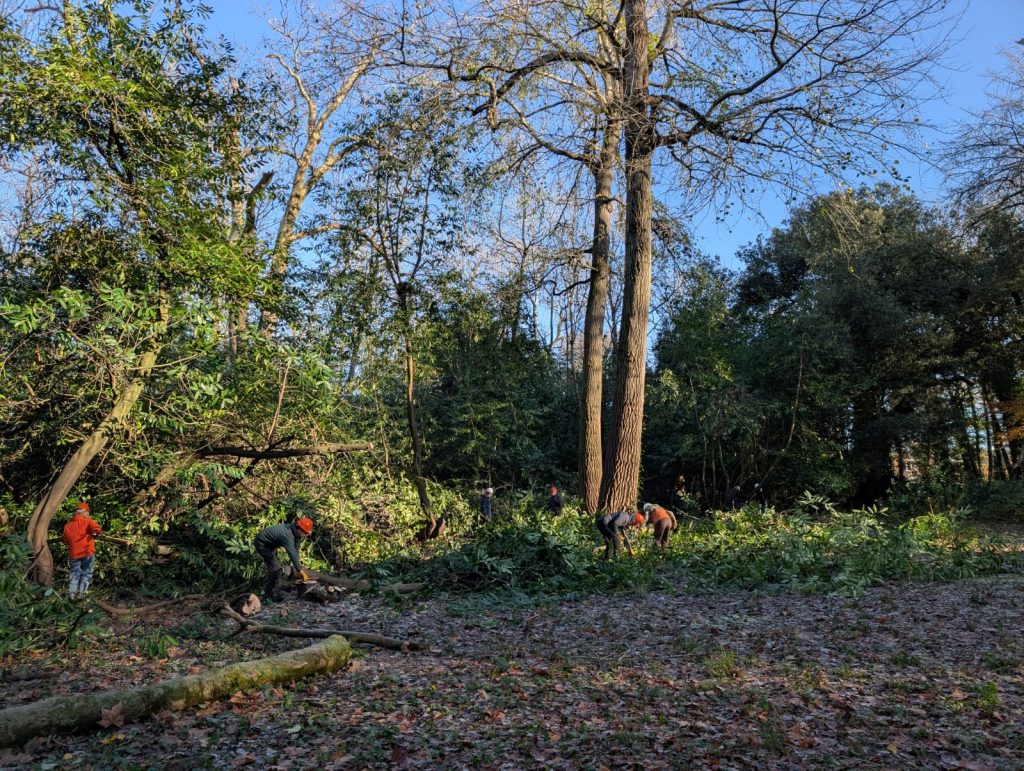
Cherry laurel is an extremely pervasive evergreen shrub, which can regenerate itself even when cut completely from its roots. Clearing the laurel is important for biodiversity. Laurel’s evergreen leaves create heavy, permanant shade. Removing the laurel therefore enables more sunlight to reach the woodland floor, allowing a wide range of native flora to grow and bloom. This in turn provides habitat for a wide range of species of mammals, birds and creepy crawlies, which are all essential for a healthy woodland ecosystem.
Overall, the goal is to remove as much laurel as possible over winter, when there is lowest chance of disturbing nesting birds and other wildlife, and in the most effective way to keep it at bay: cutting it as low to the ground as possible.
However, Stoke Park is also a Grade II listed parkland, thanks to the 18th century landscape garden of Thomas Wright. Part of his vision for the landscape of the Park included a Great Saloon – essentially a large circle of laurel – in Hermitage Wood. This needs to be retained – as much as is practical – as part of conservation of this historically significant landscape and so this winter we have focused on removing laurel from inside the saloon, which has become overgrown over the years, while retaining the outer hedge.
The Great Saloon now feels like a much more open space, while more closely (although not precisely) preserving Thomas Wright’s original vision for the space.
Hermitage Wood is a more modern name for this part of the Park. In 1725 it was known as Island Copsie and, by 1768 as Lawn Wood. Maps from the time indicate that there as a second circle or semicircle attached to the north of the Great Saloon, and this was the site of Bladud’s Cell, otherwise known as the Hermitage Lodge. The wood’s present day name is therefore likely connected to this. Bladud’s Cell was one of the first buildings to go up in the Park in 1750. However, it has been lost under the laurel growth and, at this stage, it would be challenging to establish the area back to its original design. So for now, the Great Saloon remains the large open space of Thomas Wright’s design, with the wood it sits within paying homage to Bladud’s Cell via its name: Hermitage Wood.
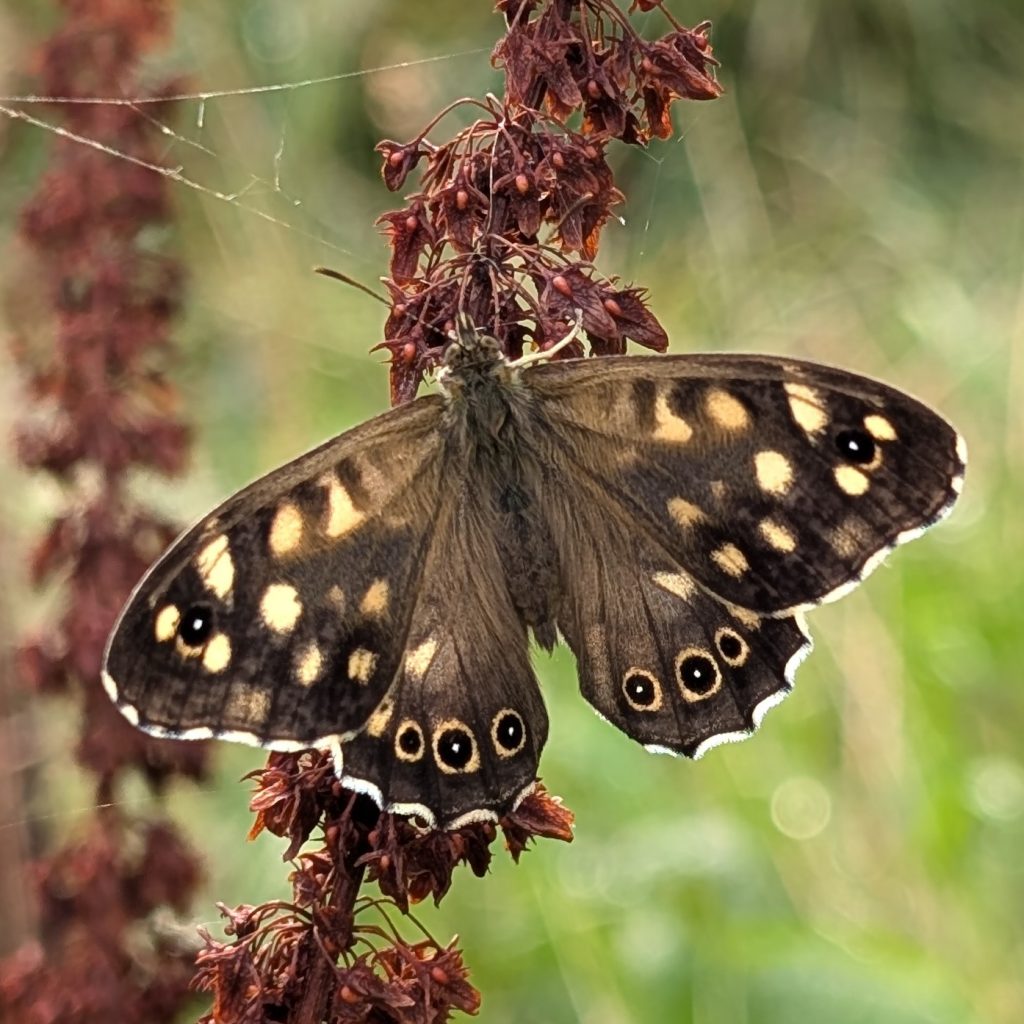
With spring not too far away it will be interesting to see what plants and flowers emerge into this open space. Take a walk through the wood in the next few months and you might spot bluebells, snowdrops, cyclamen and ferns, amongst many others. You may also see a wealth of butterflies; this is something we will be monitoring with our annual butterfly transect, which runs through the Park, including a section in the Great Saloon.
Find out more
If you would like to find out more about laurel clearance, butterfly surveys or a whole wealth of other activities you can get involved in at Stoke Park, then contact us to get involved.
Stoke Park Community Group is a welcoming group of volunteers working with the Stoke Park Ranger to carry out a wide range of conservation management tasks. We meet every Thursday and two Saturdays a month 10am-12:30pm, and there is always a hot drink and biscuit on offer. Read more about the day in the life of a volunteer.
This article was amended on 10 January 2026 to include detail about Bladud’s Cell.